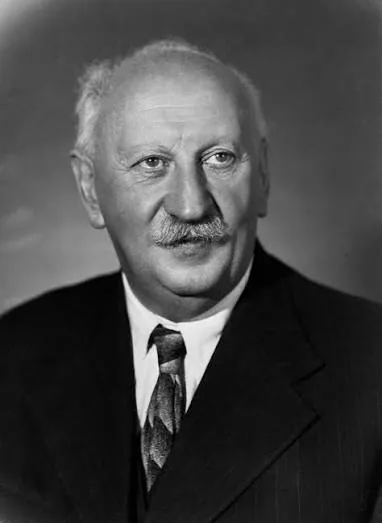
Abram Ioffe
1880–1960
physicist and science organiser
Abram Ioffe was born in Romny and finished the town's Realschule before entering the St Petersburg Technological Institute, where he studied from 1897 to 1902. He then spent four years in Munich in the laboratory of Wilhelm Röntgen, taking…
Abram Ioffe was born in Romny and finished the town's Realschule before entering the St Petersburg Technological Institute, where he studied from 1897 to 1902. He then spent four years in Munich in the laboratory of Wilhelm Röntgen, taking his doctorate there in 1905.
Back in Russia he defended his master's thesis in 1913 and his doctorate in 1915, and was elected professor of general physics. He became the chief organiser of Soviet physics: he helped found the physico-technical department of the Roentgenological and Radiological Institute (1918), the physico-mechanical faculty of the Polytechnic Institute (1919), the Physico-Technical Institute (1921) and the Physico-Agronomical Institute (1932), and pushed for similar institutes in industrial centres across the USSR, among them Kharkiv and Dnipropetrovsk.
During the Second World War he worked in Kazan and chaired the naval and military engineering commissions. In the post-war campaign against so-called cosmopolitans he was dismissed as director of the Physico-Technical Institute. From 1952 he led the Academy's semiconductor laboratory, and from 1955 its Institute of Semiconductors.
His research concerned the electrical, photoelectric and mechanical properties of crystals. He was among the first to study semiconductors, and proposed that they could convert radiation into electricity efficiently — the principle on which solar cells work. His students included Pyotr Kapitsa, Igor Kurchatov, Anatoly Alexandrov and Yulii Khariton.
Corresponding member of the Russian Academy of Sciences from 1918 and full member from 1920; vice-president of the USSR Academy of Sciences in 1926–29 and 1942–45. Corresponding member of the Göttingen and Berlin academies and of the American Academy of Arts and Sciences, honorary doctor of the University of California and the Sorbonne, honorary member of the French, British and Chinese physical societies.
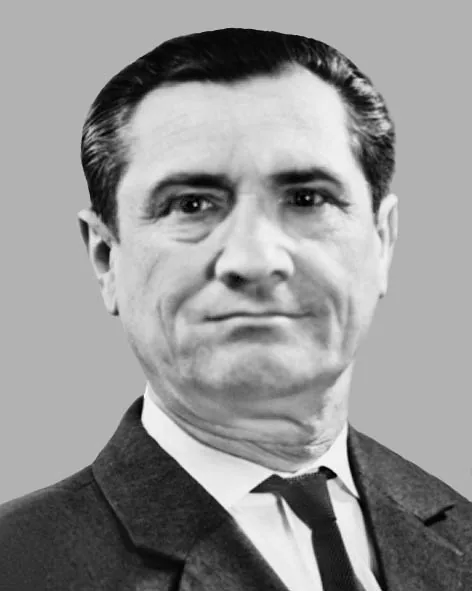
Vasyl Korshak
1908–1988
chemist, academician
Vasyl Korshak was the eldest of four children of a railway foreman. He finished vocational school in Romny in 1926 and worked as a carpenter at the Romny station of the Southern Railway before entering the Mendeleev Institute of Chemical…
Vasyl Korshak was the eldest of four children of a railway foreman. He finished vocational school in Romny in 1926 and worked as a carpenter at the Romny station of the Southern Railway before entering the Mendeleev Institute of Chemical Technology in Moscow, graduating as a process engineer in 1931.
In 1938 he founded the laboratory of high-molecular compounds at the Academy's Institute of Organic Chemistry and led it for fifty years, until his death. He headed the department of organic synthesis at the Mendeleev Institute from 1938 to 1953 and its department of plastics technology from 1958 to 1988, and edited the journals Uspekhi Khimii (1951–1972) and Vysokomolekulyarnye Soyedineniya (1973–1988). He was elected a corresponding member of the USSR Academy of Sciences in 1953 and a full member in 1976.
His work was in polymer chemistry. He established the main regularities of polycondensation, discovered non-equilibrium polycondensation and other polymer-forming reactions, and with his colleagues synthesised a great many new polymers — including, in 1961, carbyne, a third allotropic form of carbon. The production technology for the synthetic fibres anid and lavsan was developed under his direction, and with S. Rafikov he was the first in the USSR to synthesise fibre-forming polyamides.
He wrote more than 30 monographs and 1,500 papers, held several hundred inventor's certificates and nearly 100 foreign patents, and supervised 35 doctoral and over 20 candidate theses. State Prize of the USSR in 1949 and 1951, Lenin Prize in 1986; foreign member of the academies of sciences of Finland and the German Democratic Republic.
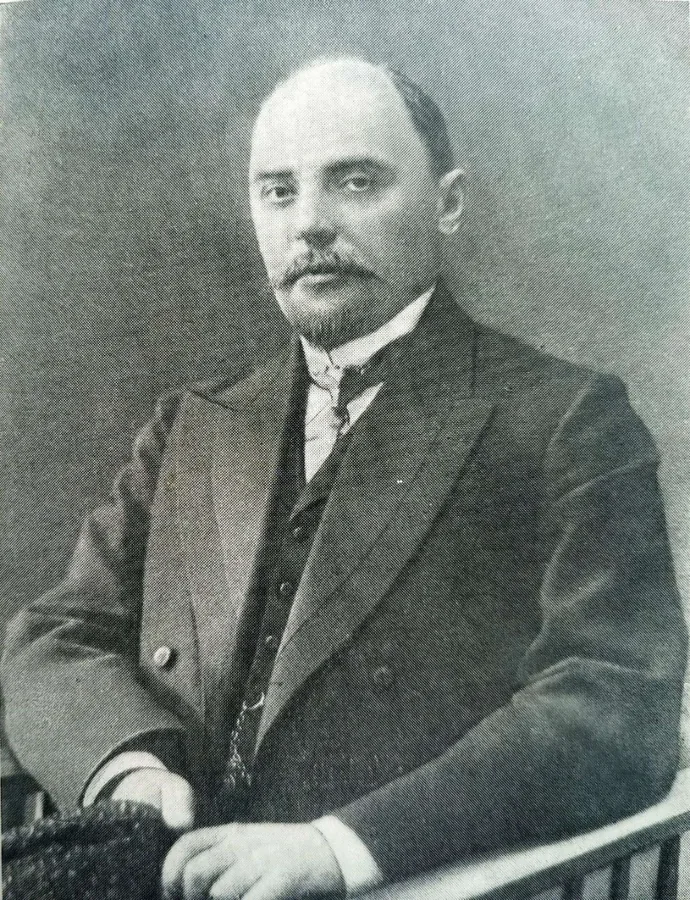
Vasyl Chahovets
1873–1941
physiologist
Vasyl Chahovets was born on the Patychykha khutir near the village of Zaruddia in the Romny district. After graduating from the Military Medical Academy in 1897 he served as an army doctor, and from 1903 to 1909 worked on physiology in…
Vasyl Chahovets was born on the Patychykha khutir near the village of Zaruddia in the Romny district. After graduating from the Military Medical Academy in 1897 he served as an army doctor, and from 1903 to 1909 worked on physiology in Ivan Pavlov's laboratory at the same academy.
His 1906 dissertation, "An outline of electrical phenomena in living tissue from the standpoint of recent physico-chemical theories", applied Svante Arrhenius's theory of electrolytic dissociation to living tissue. It made him one of the founders of electrophysiology. His later work dealt with the physico-chemical nature of electrical potentials in living tissue and the mechanism of electrical stimulation, with mathematical methods in biology, and with electronarcosis.
From 1910 he was professor and head of the physiology department in the medical faculty of St Volodymyr University in Kyiv, later the Kyiv Medical Institute. He secured 20,000 roubles for a physiological laboratory and spent it on the newest electrophysiological instruments of the day — rheostats, string galvanometers, chronometers — and worked persistently to have such apparatus manufactured in Ukraine.
He was elected to the Academy of Sciences of the Ukrainian SSR in 1939. He lived in Kyiv on Velyka Zhytomyrska Street, died there on 19 May 1941 and is buried in Lukianivske cemetery. In 2013 the National Academy of Sciences of Ukraine established a prize in his name.
Ivan Savchenko
1862–1932
microbiologist and immunologist
Ivan Savchenko was born in the Romny district, into a family from the Lubny regiment lands of the Hetmanate. He graduated in medicine from Kyiv University and worked there until 1895. A student of Hryhorii Minkh and an associate of Illia…
Ivan Savchenko was born in the Romny district, into a family from the Lubny regiment lands of the Hetmanate. He graduated in medicine from Kyiv University and worked there until 1895. A student of Hryhorii Minkh and an associate of Illia Mechnikov, he spent 1896 at the Pasteur Institute in Paris studying the physical nature and mechanism of phagocytosis.
Three years earlier, in 1893, he and Danylo Zabolotnyi had performed a dangerous experiment on themselves: after a trial immunisation they drank a live cholera culture to prove that immunisation by mouth works. That experiment began the practice of enteral vaccination.
From 1896 to 1919 he worked at Kazan University, from 1897 as extraordinary professor of general pathology. He was the first there to teach bacteriology to students, in 1903, and founded the Kazan Bacteriological Institute; in 1905 he announced his discovery of the scarlet fever toxin.
In 1919 he took Ukrainian citizenship and returned to the Ukrainian People's Republic, which was soon occupied by Bolshevik Russia. In 1920 he moved to the Kuban, where he was professor at Kuban University and from 1922 at its medical institute, teaching general pathology and medical microbiology. He founded and directed the Kuban Chemical and Bacteriological Institute and organised the region's anti-epidemic service, working against malaria, typhoid and scarlet fever.
He published more than 100 scientific works on infectious pathology, immunity, phagocytosis, oncology and pathological histology, and on leprosy, cholera, anthrax, relapsing fever, rheumatism and pneumonia.
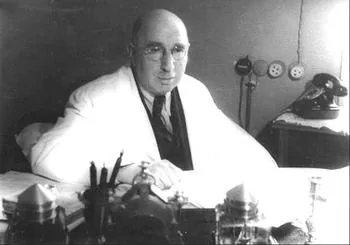
Maks Hubergrits
1886–1951
physician, doctor of medical sciences
Maks Hubergrits was born in Dorpat, now Tartu in Estonia, where his father was studying medicine; some sources give Romny as his birthplace. He finished the Revel Alexander gymnasium with a gold medal in 1904 and began medicine at Yuriev…
Maks Hubergrits was born in Dorpat, now Tartu in Estonia, where his father was studying medicine; some sources give Romny as his birthplace. He finished the Revel Alexander gymnasium with a gold medal in 1904 and began medicine at Yuriev University, transferring in 1905 to St Volodymyr University in Kyiv, where he graduated with distinction in 1911. He stayed on at the university clinic under Vasyl Obraztsov.
From 1915 to 1917 he worked in the laboratory of Ivan Pavlov, defending his doctoral dissertation there on the most effective way of differentiating external stimuli, and carrying out the experiments behind their joint paper "The reflex of freedom" (1915).
He returned to Kyiv in 1918. He headed the department of special pathology and internal medicine at the Kyiv Medical Institute from 1920 to 1928 and its department of propaedeutics of internal medicine from 1928 until his death, also running the institute's infectious diseases department in 1925–27 and the clinical divisions of the Ukrainian Research Institute of Nutrition from 1930 to 1941.
He published about 150 scientific works, including six monographs, mainly on the physiology and pathology of circulation and digestion, endocrinology, therapeutic nutrition, neurohumoral regulation, pain and electrocardiography. He proposed methods for studying pancreatic function and described a number of signs of chronic pancreatitis and appendicitis. More than 30 candidates and doctors of science trained under him.
He died on 6 May 1951 of a myocardial infarction that he had diagnosed in himself — against the insistence of the professors who examined him, who suspected acute abdominal surgical disease. He left instructions that his heart be examined after death. The infarction was confirmed.
He loved music and painting and was on friendly terms with the writers Ostap Vyshnia, Wanda Wasilewska, Semen Skliarenko and Natan Rybak. Academician of the Academy of Sciences of the Ukrainian SSR from 1949.
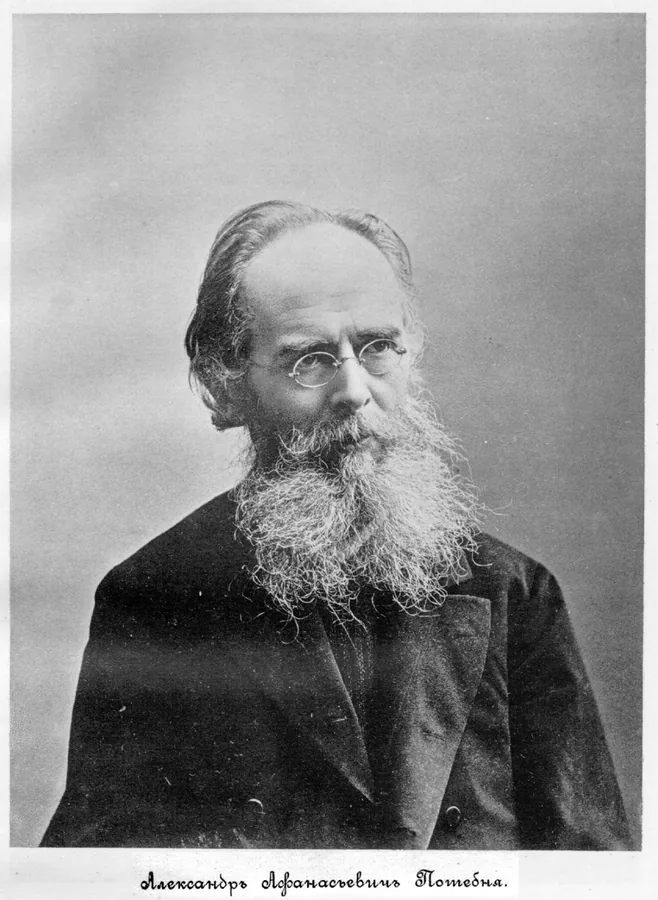
Oleksandr Potebnia
1835–1891
linguist and folklorist
Oleksandr Potebnia came from a Cossack family and was born on the Maniv khutir near the village of Hryshyne. He studied at the Radom classical gymnasium, then at Kharkiv University — law from 1851, history and philology from 1852 to 1856.…
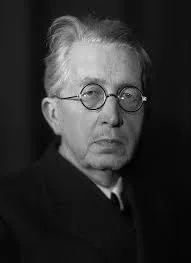
Oleksandr Potebnia came from a Cossack family and was born on the Maniv khutir near the village of Hryshyne. He studied at the Radom classical gymnasium, then at Kharkiv University — law from 1851, history and philology from 1852 to 1856.
From 1856 he taught at the First Kharkiv Gymnasium. After defending his master's thesis, "On some symbols in Slavic folk poetry", he became a docent in the department of Slavic linguistics at Kharkiv University in 1860. His doctoral dissertation, "From notes on Russian grammar", followed in 1874, and he was made professor in 1875.
His work covered the theory of literature, ethnography, phonetics, morphology, syntax and general linguistics. He studied the relationship between language and thought, between language and nation, and the origins of languages — questions that made him one of the most influential Slavic linguists of the nineteenth century.
He founded the Kharkiv Historical and Philological Society in 1877 and the Czech Society of Sciences in 1887, and was a full member of the Society of Friends of Natural Science, Anthropology and Ethnography from 1890. Corresponding member of the St Petersburg Academy of Sciences from 1877; awarded the Lomonosov Prize in 1877, the Academy's gold medal in 1878 and the Konstantinov gold medal in 1891.
Oleksii Borysiak
1872–1944
geologist and palaeontologist, academician
Oleksii Borysiak was born in Romny. His grandfather on his father's side, a professor at Kharkiv University, was among the first to study the Donets coal basin; his mother's father, Colonel Polzykov, was a hero of the Sevastopol campaign…
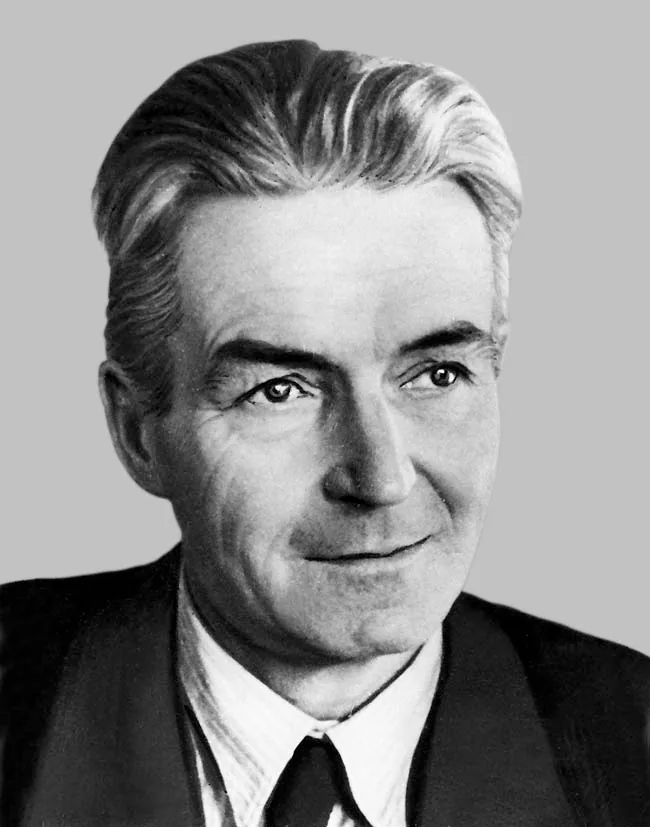
Oleksii Borysiak was born in Romny. His grandfather on his father's side, a professor at Kharkiv University, was among the first to study the Donets coal basin; his mother's father, Colonel Polzykov, was a hero of the Sevastopol campaign of 1855–56. His mother, a well-known pianist, saw to it that Oleksii and his two younger brothers had a thorough education in music, foreign languages and literature.
His father built railways, so the family moved often — Romny, Sumy, Kremenchuk, St Petersburg, Kobryn, Brest-Litovsk, Samara. He finished the Samara gymnasium with a gold medal and graduated from the Mining Institute in 1896, joining the Geological Committee as an assistant. On its behalf he carried out geological surveys in the Izium district of Kharkiv province in 1897–98 and in Crimea from 1900 to 1913. Poor health moved his work to Crimea and from 1912 forced him to give up fieldwork altogether.
He taught from 1911 and later became professor; corresponding member of the USSR Academy of Sciences in 1923 and full member in January 1929. From 1930 he organised and directed the Academy's Palaeontological Institute, and remained its director until his death.
His best-known work is in evolutionary palaeontology. He described new genera and species of fossil mammals, among them the giant Oligocene Indricotherium, and tied the development of organisms closely to the evolution of the earth's crust. He began studying fossil vertebrates in 1908, when he found the so-called Hipparion mammal fauna in Sarmatian deposits near Sevastopol. His work on fossil mammals made him one of the best-known palaeontologists of the twentieth century.
He also became one of the leading authorities on the geology of Crimea. He was the first to identify the systematic development of landslides and rockfalls on its southern shore and to establish their basic type — a finding that mattered for the economy of the region as much as for its geological history. The ten-verst geological map of Crimea was published under his editorship in 1921. Between 1904 and 1916 he published monographs on gastropod and cephalopod molluscs from Jurassic deposits of the Donbas, and with M. Yakovlev compiled a geological map of the north-western edge of the Donbas that showed Triassic deposits there for the first time.
He wrote the textbooks "A course of palaeontology" (three parts, 1905–1919) and "A course of historical geology", along with many popular science articles. Despite poor health he carried a heavy administrative load: dean of the Mining Institute, head of the palaeontological section of the Geological Institute, member of the Academy's presidium and editor of several major publications.
Borys Antonenko-Davydovych
нар. 1899
writer and translator
Borys Antonenko-Davydovych was born in the village of Zasullia, now in Sumy oblast. His father, a railwayman, was transferred to Bryansk, where Borys spent his early childhood, but he returned to Romny every year. He finished the Okhtyrka…
Borys Antonenko-Davydovych was born in the village of Zasullia, now in Sumy oblast. His father, a railwayman, was transferred to Bryansk, where Borys spent his early childhood, but he returned to Romny every year.
He finished the Okhtyrka gymnasium in 1917 and studied at the physics and mathematics faculty of Kharkiv University and the history and philology faculty of Kyiv University, completing neither: the change of political order and his family's poverty cut both short. He took part in the Ukrainian struggle for independence, serving in the Zaporizhian Corps in 1918 and the army of the Directorate in 1919, and was commandant of Melitopol in 1918. In the 1920s he headed the education department of the Okhtyrka district, then worked in the culture section of the newspaper Proletarska Pravda and as executive secretary of the journal Hlobus.
He began writing at gymnasium; his first publications came in 1923. His work falls into two periods. The first, 1923 to 1933, produced fourteen books, among them "Dusty Silhouettes" (1925), "Knock-Knock" (1926), "The Blue Cornflower" (1927), "Death" (1928), "A Real Man" (1929) and "Across the Ukrainian Land" (1930). The novels "Sich-Mother" and "The Debt" were left unfinished; the fate of the second is unknown.
The arrests of 1933 and the suicides of Mykola Khvyliovyi and Mykola Skrypnyk drove him to Kazakhstan, where he worked on anthologies of Kazakh literature in Ukrainian and of Ukrainian literature in Kazakh. The work was never finished. On 5 January 1935 he was arrested and, on fabricated charges, sentenced to death. He served in the camps of Siblag and Bamlag as a navvy, miner, fitter, bookkeeper and medical assistant, cutting granite and frozen ground to lay railway track. Transfer to lighter work — clerk, bookkeeper, then orderly and medical assistant — is what kept him alive. He returned to Ukraine after his term, was arrested again in 1946 and imprisoned without trial, and was later sentenced to lifelong exile in a village in Krasnoyarsk krai.
He came back to Kyiv in 1957, was rehabilitated and readmitted to the Writers' Union. The second period of his work, from 1957 to 1984, brought the novel "Behind the Screen" (1961), the stories "Offence", "Temptation" and "Inflated Marks", the collections of essays "About What and How" (1962) and "In Literature and Around It" (1964), and his reflections on the Ukrainian language, "How We Speak" (1970). He translated Kvitka-Osnovianenko and the first book of Simonov's trilogy "The Living and the Dead" into Ukrainian.
In the 1960s and 1970s he kept close to the young writers who formed the dissident circles. After refusing to testify at the trial of Valentyn Moroz he was squeezed: publishers stopped printing him, which took away his income; his papers and typewriter were seized in searches; the press attacked him. Work written for the drawer in those years includes the "Siberian Novellas". Abroad — in Bulgaria, Poland, England, Canada, the United States and Australia — his books were reviewed, translated and reissued; "How We Speak" was praised in the Polish Academy of Sciences journal Slavia Orientalis in 1972, and "Behind the Screen" appeared in Polish in 1974.
His style is plain and exact. As the critic Leonid Boiko put it, he deliberately avoided unusual comparisons and showy phrasing so as not to draw the reader's attention away from the substance of the story.
A well-known campaigner for the quality of the Ukrainian language, he mocked the notice printed in Kyiv trams and trolleybuses — "The doors are opened by the driver" — in an article asking how long the passive would last, and offered the plain alternative: "The driver opens the doors."
The central municipal library for adults in Romny is named after him.
Hryhorii Nudha
1913–1994
literary scholar and folklorist
Hryhorii Nudha came from a Cossack family and was born in the village of Artiukhivka. He was schooled in his home village and then at the seven-year labour school in nearby Hlynsk. As a boy he was close to the Solohub family of kobzars and…
Hryhorii Nudha came from a Cossack family and was born in the village of Artiukhivka. He was schooled in his home village and then at the seven-year labour school in nearby Hlynsk. As a boy he was close to the Solohub family of kobzars and listened to their stories about Ostap Veresai; the Ukrainian educator Hryhorii Vashkevych, a neighbour of the family, shaped him early.
He finished the Hadiach pedagogical technical school in 1931 and began teaching in Artiukhivka. In the autumn of 1933 he fled the village, where the communists were carrying out the Holodomor, and entered the philology faculty of Kharkiv University, later moving to Kyiv and graduating in 1938. From 1936 he was a junior researcher at the Institute of Folklore of the Academy of Sciences of the Ukrainian SSR and took part in its expeditions, until in 1937 a denunciation had him accused of Ukrainian bourgeois nationalism and dismissed.
From 1938 he taught at the Poltava Pedagogical Institute, and in 1941 went to the front. Encircled near Kharkiv, he ended up in a German prisoner-of-war camp and in prison; after escaping he drifted through occupied territory. Called up again in 1944, he was soon recalled to research work at the Lviv branch of the Institute of Literature.
On 10 May 1945, the day before he was to defend his candidate's dissertation, he was arrested in Kyiv. A military tribunal sentenced him to ten years' imprisonment and five years' loss of civil rights with confiscation of property, on the standard charge of anti-Soviet agitation. Released at the end of 1951 without the right to work in his profession or live in large cities, he had the conviction lifted after Stalin's death and settled in Lviv in 1955, working at the journal Zhovten.
He joined the Institute of Literature in 1957 as a junior researcher. Formal rehabilitation in 1967 did not take his name off the blacklist, and despite a large body of work and real standing among scholars he never rose above that post; he was pensioned off in 1973. The poet Rostyslav Bratun summed up his fate: "He did the work of a whole institute and was paid less than a caretaker."
His subject was the relationship between literature and folklore, traced across the whole span of Ukrainian writing. It produced the three-volume collection "Songs and Romances of Ukrainian Poets" (Kyiv, 1956–1960) and the monographs "Parody in Ukrainian Literature" (1961) and "The Ukrainian Ballad" (1970). He compiled exemplary anthologies of dumas, chumak songs, ballads, folk satire and humour, and published little-known finds such as "The Correspondence of the Zaporozhians with the Turkish Sultan". His studies of Ukrainian students at European universities in the fourteenth to eighteenth centuries, of writing in Rus before the Cyrillic alphabet, and of the first cultural and ethnographic description of Ukraine also carry weight.
Most of his work did not appear in his lifetime; only part of it got through during the Khrushchev thaw and perestroika. Independence changed that, and "The Ukrainian Song in the World" (1989), "Do Not Fear Death" (1990) and "A Republic of Cossacks" (1991) followed in quick succession.
Early in 1993 he was widely honoured on his eightieth birthday, but his health was failing. His nomination for the Shevchenko Prize ended badly: immediately after the vote was announced, and another candidate found more deserving, he lost the power of speech, and died a few days later, on 14 March 1994. He is buried in Lychakiv cemetery in Lviv.
In 1997 the foundation named after him published his life's work, the two-volume "The Ukrainian Duma and Song in the World", and sought the same Shevchenko Prize for it. It was refused, although no formal rule barred books by deceased authors.
Dmytro Bilous
1920–2004
poet and translator
Dmytro Bilous was born in the village of Kurmany, now in the Romny district, the tenth child of a peasant family. After a seven-year school he went to Kharkiv, studied at the workers' faculty attached to the Dzerzhinsky children's labour…
Dmytro Bilous was born in the village of Kurmany, now in the Romny district, the tenth child of a peasant family. After a seven-year school he went to Kharkiv, studied at the workers' faculty attached to the Dzerzhinsky children's labour commune and worked at an electrical plant. In 1938 he entered the philology faculty of Kharkiv University, where Oles Honchar and Hryhir Tiutiunnyk were among his classmates.
He volunteered for the Red Army in 1941 and was severely wounded. After hospital he joined the radio broadcasting service for partisans and for people in the occupied territories of Ukraine, working for the stations Radianska Ukraina and Partyzanka. He wrote humorous pieces for the satirical radio journal, published in the magazine Perets and wrote verse for partisan leaflets. From 1944 he worked at the Ukrainian Radio Committee and then at the journal Vitchyzna.
He graduated from the philology faculty of Kyiv University in 1945 and completed postgraduate study in Ukrainian literature in 1948. From 1947 to 1951 he was deputy editor of the journal Dnipro. In 1958 he spent time in Bulgaria studying the language and its literature. He was executive secretary of a commission of the Writers' Union of Ukraine from 1968 to 1976 and then head of its literary translation commission, and from 1980 worked as a writer full time.
He published more than twenty poetry collections, along with books of humour and satire, books for children, and literary studies of Ukrainian writers. A member of the Writers' Union of Ukraine from 1947, he became a corresponding member of the National Academy of Educational Sciences of Ukraine in 1994 and an honorary academician in 2000. He died in Kyiv on 13 October 2004 and is buried in Baikove cemetery.
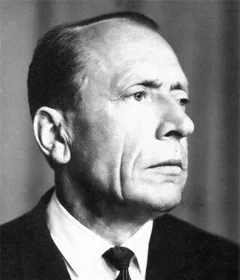
Pavlo Kliuchyna
1914–1972
poet and fabulist
Pavlo Kliuchyna was born in the village of Velykyi Sambir in the Konotop district. He finished the seven-year school in his home village, teacher training courses in Konotop and the Hlukhiv Teachers' Institute. For many years he taught in…
Pavlo Kliuchyna was born in the village of Velykyi Sambir in the Konotop district. He finished the seven-year school in his home village, teacher training courses in Konotop and the Hlukhiv Teachers' Institute.
For many years he taught in schools of the Konotop district, then worked as a correspondent for the regional newspaper Leninska Pravda, and from 1969 until his death as a research officer at the Romny Local Lore Museum.
He fought in the Second World War and held both combat and civilian decorations.
He began publishing regularly in 1944. His collections include "Fables", "Nettle", "The Lion, the Donkey and the Hare", "New Fables", "Wheat and Tares", "Nightingales and Frogs", "A Fly in the Apiary" and "Drops of the Earth's Colours".
He also left a mark on local history writing, producing historical, literary and art-historical studies and co-authoring the local history essay "Romny".
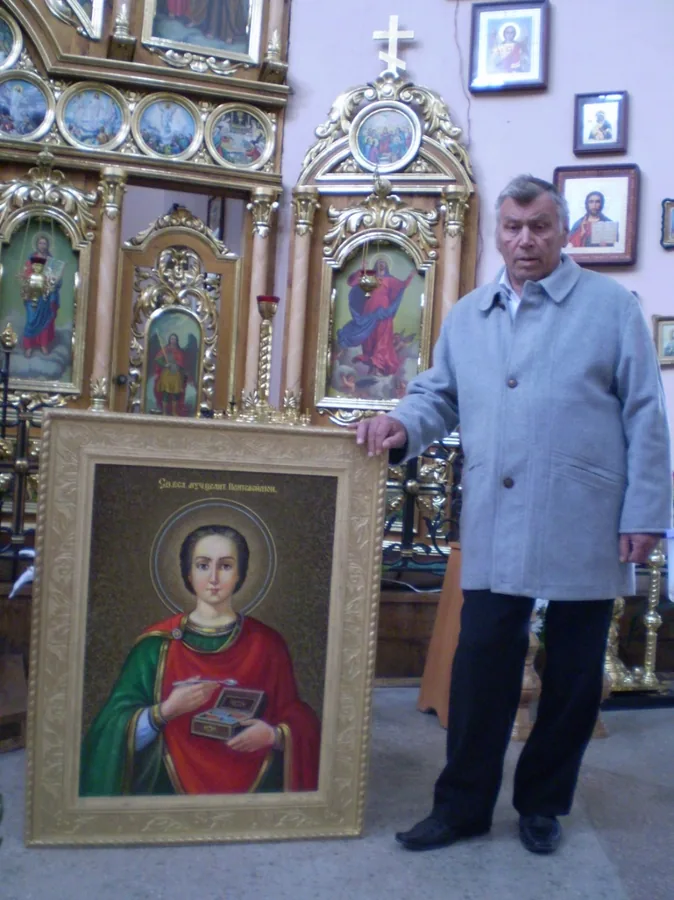
Valerii Zosenko
1939–2010
painter
Valerii Zosenko was born in Romny into a family of painters, Kuprian and Mariia Zosenko. His father, who fought in the Second World War, taught drawing at Romny School No. 2 — the school Valerii himself attended, and former pupils still…
Valerii Zosenko was born in Romny into a family of painters, Kuprian and Mariia Zosenko. His father, who fought in the Second World War, taught drawing at Romny School No. 2 — the school Valerii himself attended, and former pupils still remember his lessons. For much of his own career Valerii taught drawing too, first in Rivne oblast and then in Romny.
He decorated the town for public holidays and worked on restoration in the local lore museum and in the Ascension Church. A gifted copyist and a master of glazing technique, he painted a great many commissioned pictures. His murals remain with the congregations of churches across Sumy oblast.
His work covers nearly every kind of visual art — landscapes, portraits, historical compositions and icons — and he worked equally in easel and monumental painting. He exhibited widely and won national themed competitions. His palette is built on clear, transparent colour, with light and an elevated mood almost always prevailing.
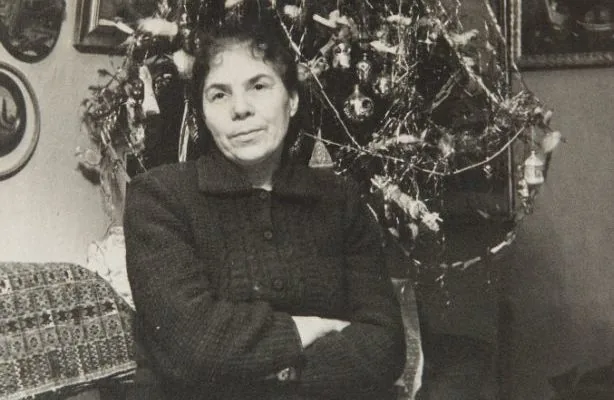
Lina Breus
1904–1983
painter
Lina Breus was born in 1904 into the family of a medical assistant in the village of Lypove, then in Chernihiv province, and lived in Romny. She had her first art training in the private studio of Mykhailovskyi, a painter and professor of…
Lina Breus was born in 1904 into the family of a medical assistant in the village of Lypove, then in Chernihiv province, and lived in Romny. She had her first art training in the private studio of Mykhailovskyi, a painter and professor of the Academy of Arts, while he was staying in Romny during the famine.
She studied at the Kyiv State Art Institute in 1934–35 but had to leave for want of money. She worked in portrait, landscape and thematic painting, taught drawing in village schools and later ran a private art studio in Romny.
She was a believer and made her confession to Illia Lopatko, priest of the Ascension Church, to whom she left all her property. Only a few of her works survive, among them a copy of Savrasov's "Early Spring" and the landscape "Chyzhykiv Khutir". She kept diaries, illustrating them with drawings and setting down her memories, her joys and hardships, her successes and the plans that never came off. In drawing lessons she would read those pages to her pupils and show them her own work.
She gave her life to children — teaching them to draw, and to notice what is beautiful. Her pupils included the art historian Valentyna Yefremova, the architect Oleksandr Dymshyts, the architect Oleksandr Tamarov, the painters Volodymyr Lytvynenko, Valerii Zosenko and Nina Poluian-Vnukova, and many others. The art studio "Etiud" in Romny carries her name.
She was close to the local artists Semenchyk, Tsiupka, Riznyk, Zhelaiev and Varshavskyi, and to the family of the sculptor Ivan Kavaleridze.
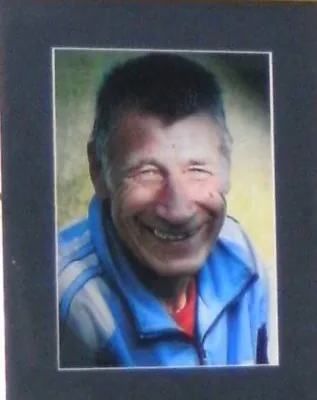
Mykola Samokhin
1943–2009
painter
Mykola Samokhin was born in the village of Perekopivka in the Romny area. His school drawing teacher, Vitalii Pyvovarov, gave him his love of the craft, and Samokhin spoke of him with gratitude all his life. After school he studied at the…
Mykola Samokhin was born in the village of Perekopivka in the Romny area. His school drawing teacher, Vitalii Pyvovarov, gave him his love of the craft, and Samokhin spoke of him with gratitude all his life.
After school he studied at the Lokhvytsia technical school of food industry without giving up art, then served in the army. For many years he worked at the Romny art workshop.
He painted large canvases in oil and worked in graphics. He designed the Feodosii Sakhno museum in Smile and the workshop-museum of the mother-heroine Oleksandra Derevska, helped create the gallery at the municipal culture centre, and illustrated books and the literary and historical almanac "Romen". His love of the region runs through the canvases he devoted to the history of the Romny land.
In 2005 he took part in the closing exhibition of the "Bridge of Friendship" plein air, held for the Year of Georgia in Ukraine with the support of the Georgian embassy, alongside artists of the "Mystetska Svitlytsia" association and painters from Georgia.
He had no formal art education, but he saw beauty around him and passed it on. Many of his works are in private collections, in the Culture Fund of Ukraine and in the Sumy regional society in Kyiv. He never learned to make money from his art, being used to giving it away. He died on 4 November 2009 and is buried in Romny.
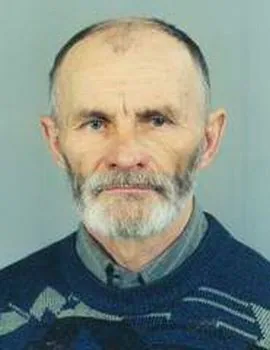
Oleksii Severyn
1943–2004
painter and restorer
Oleksii Severyn was born in Romny on 30 March 1943 and died there on 29 May 2004. He was a painter and restorer, and served three terms as a deputy of the Romny city council. He gave himself fully to whatever he was doing, in the…
Oleksii Severyn was born in Romny on 30 March 1943 and died there on 29 May 2004. He was a painter and restorer, and served three terms as a deputy of the Romny city council.
He gave himself fully to whatever he was doing, in the knowledge that life allows no rough drafts. On every major holiday he travelled to Andriivskyi Descent in Kyiv — to look at the work on show, buy materials and talk to other artists.
Once he remarked that he had gone out that morning and suddenly noticed how high the fresh green grass had grown, and that he had long meant to paint a landscape with spring grass. There was regret in his voice: circumstances kept him from carrying out all he had planned. He did a great deal even so, and his work is accomplished and probably still not fully appreciated.
Wherever artists set up to paint in Romny, people would come over and say that the painter with the little beard used to work in that very spot — and the newcomers would feel they were following in his footsteps. Many of the views he painted are gone now and survive only in his pictures.
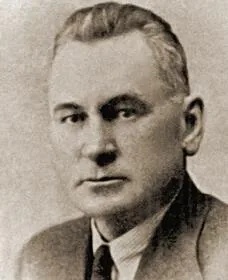
Serhii Tymoshenko
1881–1950
architect and public figure
Serhii Tymoshenko was born in the village of Bazylivka in Chernihiv province, brother of Volodymyr and Stepan. His father had been a serf who obtained his freedom, educated himself at home, completed surveyors' courses in Kharkiv and, once…
Serhii Tymoshenko was born in the village of Bazylivka in Chernihiv province, brother of Volodymyr and Stepan. His father had been a serf who obtained his freedom, educated himself at home, completed surveyors' courses in Kharkiv and, once he had capital, married the daughter of a retired officer. Serhii's first teacher was his mother; the teacher Mykhailo Kovalenko later prepared him for the Romny Realschule. After finishing it he studied at the Institute of Civil Engineers.
As a student he was active in the Ukrainian Students' Community and a member of the northern committee of the party that became the Ukrainian Social Democratic Workers' Party. He was wounded at demonstrations twice, in 1902 and more seriously in 1905, and was discharged from regular military service on health grounds.
After graduating he worked in Kovel, Kyiv, Kharkiv and Lubny, building houses in the Ukrainian style and designing garden cities. From 1907 he entered exhibitions and competitions in Kyiv, Kharkiv and Yelysavethrad, winning more than ten awards — for a provincial hospital, a church for two thousand parishioners in Kharkiv, a burial chapel in Lubny, gravestones for the composer Mykola Lysenko and the engineer Oleksandr Varianytsyn, and several people's houses. In 1912 he co-founded the Ukrainian art and architecture section of the Kharkiv literary and artistic circle.
The revolution of 1917 made him provincial commissar of the Kharkiv region; in April he was elected to the Central Rada and in November chaired the peasants' congress of Sloboda Ukraine. He served as minister of transport in the governments of Isaak Mazepa, Viacheslav Prokopovych and Andrii Livytskyi, and was the Ukrainian government's envoy in talks with the Don Host on joint operations against the Bolsheviks. He took part in the Second Winter Campaign. His Kharkiv archive is lost for good: in 1921 the Cheka took everything and carried it off by lorry.
In 1922–23 he designed churches in the Lviv suburbs of Kleparow and Levandivka and the Studite monastery at Zarvanytsia. From 1924 to 1929 he was professor at the Ukrainian Economic Academy in Poděbrady and at the Ukrainian studio of plastic art in Prague, and in 1927–28 the academy's rector. St Andrew's Church in Kleparow was built to his design between 1926 and 1932, and the Church of the Dormition in Boryslav between 1928 and 1931.
From 1930 to 1939 he was in Lutsk as chief architect for agricultural building in Volhynia, designing model farmsteads and some twenty modernist houses in the town. He led the Volhynian Ukrainian Association, sat as a deputy in the Polish Sejm from 1935 and as a senator from 1938, and campaigned for the Ukrainisation of the Orthodox Church in Poland. He was the first head of the Metropolitan Petro Mohyla Society, founded in Lutsk in 1931, which set up branches across Volhynia and published religious literature in Ukrainian. In October 1933 he became deputy head of the Volhynian public committee to help the starving in Soviet Ukraine.
He spent 1940–41 in Lublin and 1941–43 in Lutsk. In 1943 he was conscripted into the German Todt construction organisation and worked in Przemyśl, Lviv, Dalmatia, Zagreb, Graz, Prague, Karlsbad and Heidelberg. After the defeat of Germany he ended up in a displaced persons camp; only his pre-war Polish citizenship saved him from being handed over to the Soviet authorities.
In 1946 he emigrated to the United States and designed churches and other buildings for Ukrainian communities in Canada, Argentina, Paraguay and the USA. He died of a heart attack in Palo Alto, California, on 6 July 1950, leaving unfinished a church design for Buenos Aires.
About 400 buildings were put up to his designs. He made the gravestone for Symon Petliura in Paris. Seeking to revive a Ukrainian style, he drew on the heritage of Ukrainian art and particularly on the masonry architecture of Ukrainian baroque. His son Oleksandr also became an architect, chief architect of the Washington metro and a founder of the Society of Ukrainian Engineers of America.
He was awarded the Symon Petliura Cross, and under Ukrainian law is recognised as a fighter for the independence of Ukraine in the twentieth century.
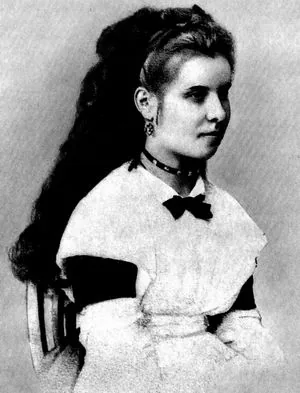
Hanna Zatyrkevych-Karpynska
1856–1921
actress, a leading figure of Ukrainian theatre
Hanna Zatyrkevych-Karpynska was born in Sribne, now in Chernihiv oblast, and died in Romny. From her youth she took an active part in amateur productions in Pryluky and Romny. In 1883 she joined the professional company of Mykola…
Hanna Zatyrkevych-Karpynska was born in Sribne, now in Chernihiv oblast, and died in Romny.
From her youth she took an active part in amateur productions in Pryluky and Romny. In 1883 she joined the professional company of Mykola Sadovskyi, and afterwards worked with a succession of theatre companies across Ukraine in the late nineteenth and early twentieth centuries. In 1919–20 she played at the State People's Theatre in Kyiv under Panas Saksahanskyi.
Over a long career she played more than 130 roles, and is counted among the koryfei — the founding generation of Ukrainian professional theatre.
In 1920–21 she returned to Romny, where she performed with the Ukrainian company set up by the local Prosvita society.
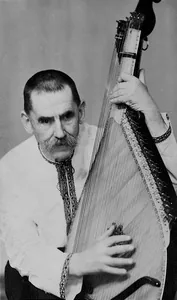
Yevhen Adamtsevych
1903–1972
kobzar, author of the Zaporizhian March
Yevhen Adamtsevych was born into the family of a minor clerk. He began to lose his sight at the age of two. At eleven he was sent to the school for the blind in Kyiv but did not finish it, because the family moved to Romny — and there he…
Yevhen Adamtsevych was born into the family of a minor clerk. He began to lose his sight at the age of two. At eleven he was sent to the school for the blind in Kyiv but did not finish it, because the family moved to Romny — and there he began playing the bandura at the fairs.
In 1925 he took lessons from the kobzar Musii Oleksiienko. From 1927 he worked on his own, touring with other kobzars. He was invited to the republican conference of kobzars and lira players in 1937 and took part in the all-union conference of folk singers in 1938.
Through the Nazi occupation he travelled the villages of Sumy oblast, and went back to performing after the war. In 1968–69 he appeared in Kyiv in kobzar concerts organised by the Republican Music and Choral Society of Ukraine, and in 1970 he performed at the Gorky Institute of World Literature in Moscow and at the writers' house there.
He is remembered above all as the author of the Zaporizhian March.
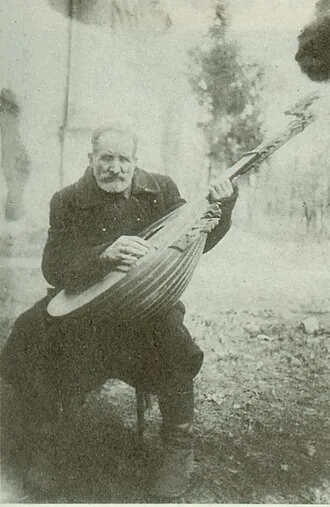
Musii Oleksiienko
1871–1945
bandura and torban player
Musii Oleksiienko was born in the village of Protsivka, later absorbed into Romny. His love of music came largely from his mother, who had a fine voice and knew a great many folk songs. As a boy working as a gardener he used to listen…
Musii Oleksiienko was born in the village of Protsivka, later absorbed into Romny. His love of music came largely from his mother, who had a fine voice and knew a great many folk songs. As a boy working as a gardener he used to listen under the window to a visiting student playing the violin; the young man noticed him, took him in and taught him to play and to read music, and his stepfather, a skilled craftsman, made him a violin.
In 1892 he became a telegraph apprentice at Romny station on the Liubava–Romny railway and worked in that trade all his life, reading widely in his own time — literature, history, theatre — and above all listening to music.
Kobzars often came to the Romny fairs, and their playing drew him in. He bought an old bandura, taught himself, and built up a repertoire from many folk singers. From his youth he wrote down the words and the music of songs and dumas, beginning with those his mother sang and going on to old people whose memory held the old songs; he travelled the villages of the Romny area specially to find such singers. Besides the violin he played the guitar, the mandolin and wind instruments, and earned extra money tuning pianos in the houses of well-off townspeople, spending it on sheet music, books and instruments.
His work reached its widest scope during the struggle for independence in 1917–21, when theatre, education and the national movement all revived. He returned to Romny and threw himself into the town's artistic life, performing with the bandura at the People's House, at the village theatre in Protsivka and at the many fairs of the district. In those years he knew and worked with Hanna Zatyrkevych-Karpynska, with the sculptor and theatre director Ivan Kavaleridze, and with Stepan Shkurat, Iryna Volykivska and Vasyl Yaremenko, then still amateurs.
October 1918 stayed with him: Kavaleridze finished the first monumental statue of Taras Shevchenko, and Oleksiienko performed at the ceremony — solo with the bandura and in the choir. That day he met Hryhorii Vashkevych, then 92 years old, a friend of Shevchenko's who lived on a khutir near Romny. Moved by the playing, the old man invited the performers to his farm and handed Oleksiienko Shevchenko's torban. He kept it — and played it — until 1935, then gave it to the Romny Local Lore Museum, where it remains.
He was also a fine teacher. He taught many young men in Romny the violin, the guitar and wind instruments, and for years led a folk instrument orchestra in Protsivka that performed well beyond its own village. Among his pupils were his own sons Oleksandr and Mykola, who played in the wind band of the 21st rifle regiment stationed in Romny before the war, and the kobzar Yevhen Adamtsevych.
Shortly before the Second World War his elder son Oleksandr took his father's collected song transcriptions to Leningrad to try to have them published. The war began, and both the son and the manuscripts were lost in the besieged city; only a small part survives.
His last years fell in the war. Two years of occupation told on him, and his heart ached for his sons at the front and in evacuation. The late news of Oleksandr's death finished his health. He died on 8 March 1945 and is buried in Romny.
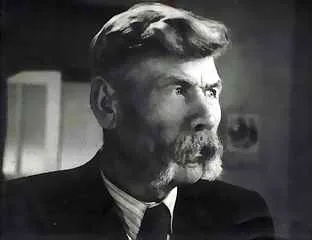
Stepan Shkurat
1885–1973
actor, People's Artist of the Ukrainian SSR
Stepan Shkurat began performing in 1905 at the People's House in Kobeliaky. In 1910 he moved with his family to Romny, where he worked as a stove-setter and played in the amateur theatre — in Starytskyi's "Marusia Bohuslavka", in…
Stepan Shkurat began performing in 1905 at the People's House in Kobeliaky. In 1910 he moved with his family to Romny, where he worked as a stove-setter and played in the amateur theatre — in Starytskyi's "Marusia Bohuslavka", in Karpenko-Karyi's "Martyn Borulia", "Vanity", "Sava Chalyi" and "The Drifter", in Kotliarevskyi's "Natalka Poltavka" and in Hulak-Artemovskyi's "Zaporozhets Beyond the Danube".
From 1918 he worked in the workers' and peasants' theatre run by Ivan Kavaleridze, who in 1928 offered him the part of the peasant Ivan in his film "The Downpour". He went on to appear in Kavaleridze's film-operas "Natalka Poltavka" and "Zaporozhets Beyond the Danube".
He is best known for his work with Oleksandr Dovzhenko: Opanas Trubenko in "Earth" (1930), Stepan Huba in "Ivan" (1932), Vasyl Khudiakov in "Aerograd" (1935) and old Prokopenko in "Shchors" (1939). In all he played close to a hundred roles for studios in Ukraine, Belarus and Georgia, among them Panas Kandyba in "Fata Morgana" (1931), Potapov in "Chapaev" (1934), Yakym Nedolia in "The Riders" (1939), Yehor Sylych in "The Swallow" (1958) and Kyrylo in "The Harlot" (1961).
For many years he sang with the Romny folk choir. Honoured Artist of the RSFSR from 1935 and People's Artist of the Ukrainian SSR from 1971, he died in Romny in 1973.
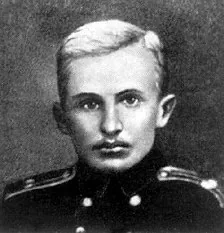
Andrii Potebnia
officer, participant of the 1863 uprising
Andrii Potebnia was born in Romny, the son of a retired staff captain. He finished the Konstantinovsky cadet corps in 1856 and served as an ensign and then a second lieutenant in the Shlisselburg regiment. Stationed with his regiment in…
Andrii Potebnia was born in Romny, the son of a retired staff captain. He finished the Konstantinovsky cadet corps in 1856 and served as an ensign and then a second lieutenant in the Shlisselburg regiment.
Stationed with his regiment in Poland, he founded the Committee of Russian Officers in Poland, a revolutionary organisation that joined the Land and Liberty society in November 1862. He established contact with the Polish secret revolutionary organisations and agreed with them on joint preparations for a rising against the tsarist government.
On 9 July 1862 he made an attempt on the life of the viceroy of the Kingdom of Poland, Grand Duke Konstantin Nikolaevich, and had to go underground.
He helped write a number of the Committee's leaflets and appeals, among them the proclamation "To the officers of the Russian forces", published in Herzen's newspaper Kolokol in May 1863. In 1862–63 he travelled to London and kept in touch with Alexander Herzen and Nikolai Ogaryov.
He took part in the Polish uprising of 1863–64 and was killed in battle against tsarist troops near Piaskowa Skała, not far from Kraków.
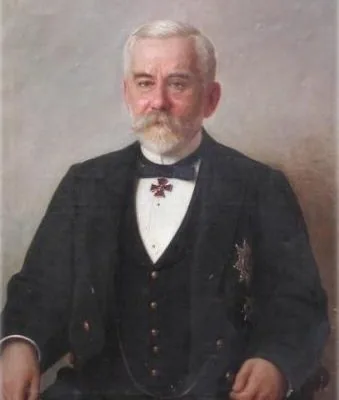
Hryhorii Navrotskyi
1833–1907
lawyer and public figure
Hryhorii Navrotskyi was born in Romny into a local noble family. He graduated in law from Kharkiv Imperial University in 1857 and from 1858 began a long career in public office in the Romny district: arbitrator, chairman of the district…
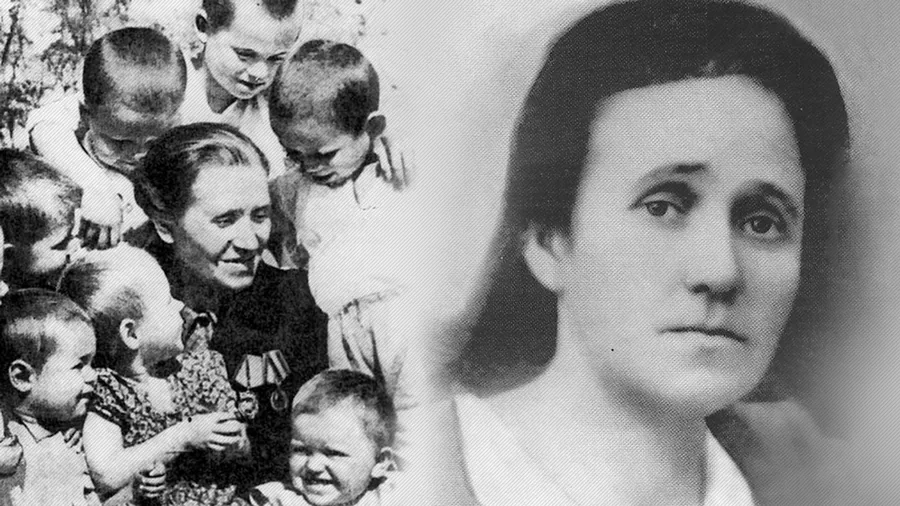
Oleksandra Derevska
1902–1959
mother-heroine who raised 48 children
Oleksandra Derevska, born Semenova, was the daughter of an oil worker in Grozny. She studied at the Grozny girls' gymnasium and qualified as a home tutor. At sixteen she became a nurse in a Red Army hospital, where she met and married the…
Oleksandra Derevska, born Semenova, was the daughter of an oil worker in Grozny. She studied at the Grozny girls' gymnasium and qualified as a home tutor. At sixteen she became a nurse in a Red Army hospital, where she met and married the soldier Derevskyi. After the civil war she worked as a nurse in hospitals in many towns, as the family moved from place to place.
In hard circumstances, and after the death of her only daughter, she began adopting children whose parents had been killed in the civil war. By the eve of the Second World War the family numbered nine. In 1942 she took in seventeen orphans evacuated from besieged Leningrad. In 1945 she moved with her large family to Romny and went on taking in orphans there.
In all she raised 48 orphaned children of eight nationalities; by some accounts the number was over sixty.
She was awarded the Order of the Red Banner of Labour and the medal for valiant labour in the war. The title Mother Heroine was conferred on her by decree in March 1974, fifteen years after her death.
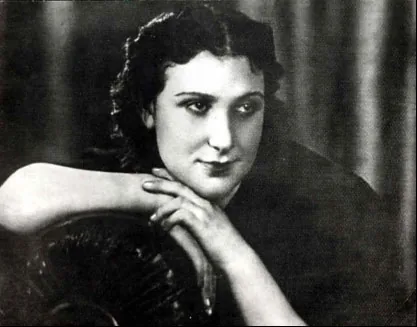
Tetiana Markus
1921–1943
member of the anti-Nazi resistance
Tetiana Markus was born in Romny into a large Jewish family. The family moved to Kyiv a few years later, and she finished nine grades of School No. 44. From 1938 she worked as a personnel clerk in the passenger service of the South-Western…
Tetiana Markus was born in Romny into a large Jewish family. The family moved to Kyiv a few years later, and she finished nine grades of School No. 44. From 1938 she worked as a personnel clerk in the passenger service of the South-Western Railway, and in the summer of 1940 was sent to Chișinău to work in the tram and trolleybus depot.
When the Romanians took Chișinău she returned to Kyiv, and from the first days of the occupation took part in the underground. She was a courier for the underground city committee and a member of a sabotage group. During a parade of the occupying forces she threw a grenade hidden in a bouquet of asters into a column of soldiers.
Forged papers registered her in a private house under the name Markusidze, with a cover story that she was the daughter of a Georgian prince shot by the Bolsheviks. Under that name she took a job in an officers' canteen and went on with her work there, putting poison in the food; several officers died and she remained unsuspected. She shot a valuable Gestapo informer herself, and passed to the underground the names of others working for the Gestapo. A senior official who had come from Berlin to fight the partisans and the underground was shot by her in his own flat. In all she killed several dozen German soldiers and officers.
After one killing she left a note: "The same fate awaits all of you, fascist vermin. Tetiana Markusidze." The hunt for her began. The underground leadership decided to move her out of the city to the partisans but could not manage it, and on 22 August 1942 she was seized by the Gestapo trying to cross the Desna. She was tortured for five months and gave no one away. She was shot on 29 January 1943.
She was named a Hero of Ukraine in 2006, posthumously. Romny Lyceum No. 4 bears her name.
Feodosii Sakhno
1918–1988
soldier and local historian
Feodosii Sakhno was born in the village of Smile in the Romny district. In 1933, at fifteen, he had to leave his father's house to escape starvation and go looking for work, making his way through the Poltava region and Zaporizhzhia.…
Feodosii Sakhno was born in the village of Smile in the Romny district. In 1933, at fifteen, he had to leave his father's house to escape starvation and go looking for work, making his way through the Poltava region and Zaporizhzhia. Before the war he served in the border troops of the Red Army. He was due to be discharged into the reserve on 21 June 1941; the war began the next morning.
The army became his profession. He served as a political instructor and organised sniper teams, and in 1942 was severely wounded in besieged Leningrad, which he survived. He was awarded the Order of the Red Star and six medals. From 1943 he served in counter-intelligence, and was discharged as a senior lieutenant in 1961 in Lviv.
He had wanted to be a painter. Before the war the young man had applied to the Academy of Arts; collectivisation, the Holodomor and the war saw to it that nothing came of that. While stationed in Sumy he did finish a three-year fine art studio course at the Sumy house of folk art in 1951–53, and later taught drawing, ran an art circle, took his pupils on excursions to the Shevchenko sites and to Kyiv museums, and combined painting with poetry. Few of his own pictures survive: a self-portrait, some landscape studies, a portrait of his daughter.
In 1963 he returned to Smile to devote himself to the history of his home region. For twenty-five years he researched the village — a Cossack company town founded in 1629 — working through thousands of archival documents and publications and recording a great many local stories, legends and songs, in an attempt to understand the history of Ukraine through the history of one place. As a child he had found the secret underground passages of the old Smile fortress, and with friends had come across chests of old books, a Cossack pistol and a powder flask.
In the years of stagnation, after one of his public talks, local officials declared him insane and raised the question of arresting him; only the intervention of republican authorities saved him from reprisal for free thinking. He kept up friendships and correspondence with the writers Borys Antonenko-Davydovych, Olesa Yushchenko, Andrii Malyshko, Volodymyr Sosiura, Dmytro Bilous, Mykola Danko and Pavlo Kliuchyna and with the artists Nestor Kizenko and Ivan Honchar. He was particularly warm towards the kobzars Yevhen Adamtsevych and Ihor Rachko, giving them shelter for long periods and editing the texts of the songs in their repertoire.
He died in Smile in December 1988, leaving a valuable archive and his letters.